
Fernsehturm
Berlin's highest building offers a spectacular view of the city from the viewing platform 203 metres above the city. This is an excellent visit to do day or night and is a great way of passing an evening in the city centre. Information about the sights is available in English and German.

Reichstag

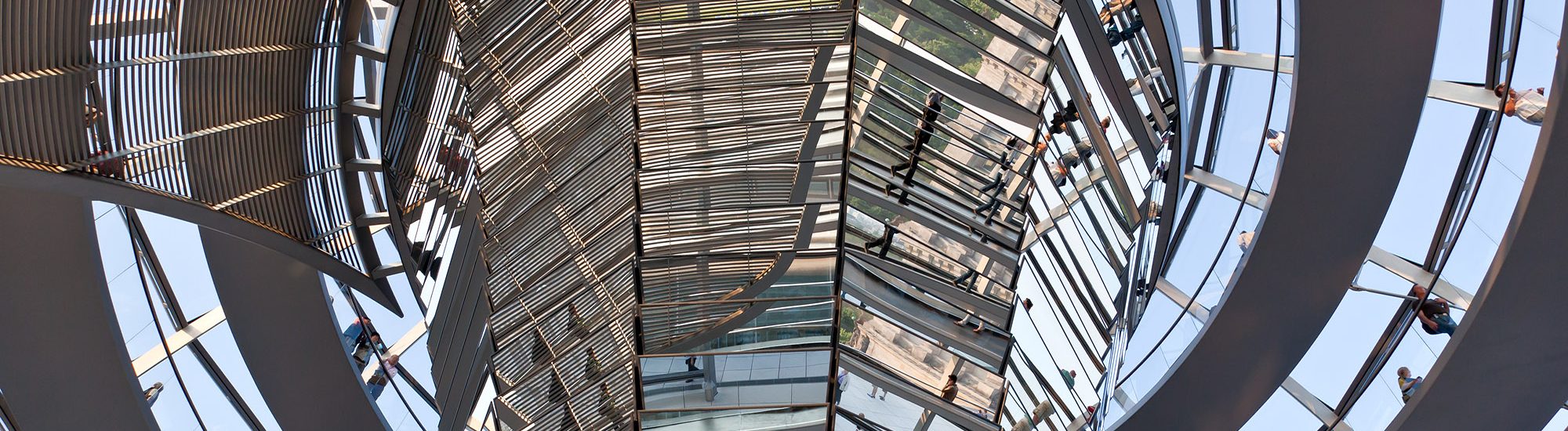
This building is a symbol of Germany's changing history. Since 1999, this has been the seat of the German Parliament and the building is open for visitors to admire and take in a spectacular view of the city from the glass dome.
Bundesrat
A tour in English or German will guide you through the parliamentary offices, with a look in on the plenary chamber and an explanation of the system of passing laws. Tours last one hour and there is time at the end allocated for questions
Charlottenburg Palace, Neues Palais and Sanssouci Park

The Charlottenburg Palace is the largest palace in Berlin. It was built in several stages. It was intended as the summer home for Sophie Charlotte, Frederick III's wife. The palace is situated in the grounds of the Neues Palais and the beautiful Sanssouci park. There are several guided tours of the various different parts of the palaces and park. Please contact us for more details.
Pergamon Museum
The highlight of this museum is the Department of Greek and Roman Antiquities, housed in the north and east wings of the museum. Enter the central hall to see the Pergamon Altar, which is so large that it has a huge room all to itself. The Near East Museum, in the south wing, contains one of the largest collections anywhere of antiquities from ancient Babylonia, Persia, and Assyria, documenting a civilisation that created ceramic, glass, and metal objects while Europe was still overrun with primitive tribes. The museum's upper level is devoted to the Museum of Islamic Art. Allow at least 2 hours for this visit.
Potsdamer Platz


See the modern side of Berlin. On Potsdam you will see the impressive Daimler-Chrysler and Beisheim buildings, shop in the Arcades and visit the spectacular futuristic Sony Centre. A visit could include seeing a film in the CineStar Original cinema or the IMAX® cinema, the Sony Style Centre or stop to eat and drink in the many bistros. For the real film-buffs, a look around the Filmmuseum for an insight into the film-making business and the history of the Hollywood and Berlin film industries is a must.
Guggenheim
This famous art gallery is housed in the ground floor of the Deutsche Bank on the corner of Unter den Linden. The exhibitions change four times a year and guided tours are available in English or German. There is also a shop selling journals on the exhibitions and a very nice café, the Kaffeebank, where you can have "Kaffee und Kuchen" after your visit and enjoy the view of the glass-roofed atrium in the old bank.
Boat Trips

Why not see the city by boat? A river tour on the Spree and through the city's canals will show you the city centre from a romantic perspective. Evening tours during the summer months make an excellent after-dinner activity. Tours last one hour. Commentary in English is available.
Haus der Wansee Konferenz
On January 20th, 1942, fifteen high-ranking civil servants and SS-officers met in this house to discuss the plan for "The Final Solution" of the Jewish question in Europe; the decision to deport the Jews of Europe to the East and murder them. On the 50th anniversary of the conference (1992) a memorial and educational centre was opened in the villa. Today it houses exhibitions of the National Socialist regime and of Jewish history. Guided tours in English or German are available, lasting 2 hours.
Gedenkstätte Deutsche Wiederstand
This Memorial was set up to remember the efforts of various groups of people who resisted the Nazis. An English or German speaking guide is available to give a tour of the exhibitions. Allow two hours for this visit.
Deutsches Historisches Museum
This museum has a series of permanent exhibitions that give an overview of German history starting from 100 AD, through the series of German Reichs into the 20th Century and the two world wars. The series of exhibitions aims to give visitors an insight into the tapestry of the nations history, displaying costumes, every-day artefacts through the ages, military artefacts and works of art, photography, technology, engineering and film. The museum is large and you may not wish to include all the exhibitions in your visit. Allow approximately 2 hours.
Checkpoint Charlie
The "Haus am Checkpoint Charlie" was started to document a history of peaceful protest against the violation of human rights. Based near the site of the "gate" from the eastern part of the city to the West, over the years they have documented escape attempts from the East and collected artefacts involved in these escapes. There are, amongst other things, pictures of one family's escape attempt in a hot air balloon, a life-size replica of an audio system speaker in which one girl travelled over the border and a very small car which carried several people to the West during various trips. There is even a life-size dummy hidden somewhere in the car which visitors have to find. There is also a strong art interest in the museum, as the exhibitions include artworks inspired by the Berlin Wall and artist impressions of the wall itself. Ghandi's worldwide non-violent fight for human rights is also documented here. Tours in English or German are available. Allow 2 hours for the visit.
Topografie des terrors
This open-air exhibition, which was originally designed to be temporary, is situated in the district which housed the various institutions responsible for the oppressive and criminal policies of the National Socialist Regime. The mission of the Topography of Terror Foundation is to provide historical information about National Socialism and its crimes as well as to stimulate active confrontation with this history and its impact since 1945. A tour in either English or German lasts approximately 1½ hours.
Alliiertenmuseum
This museum documents the Occupation of Germany by the four powers - Britain, USA, France and the USSR- and their plans for liberation and reconstruction. The exhibition follows the dramatic breakdown of relations between the Soviets and the three other occupational powers and the subsequent Cold War. It shows the part played by Berlin in the conflict, culminating in the fall of the Berlin Wall. Tours are available in English or German and last one hour.
Gedenkstätte Sachsenhausen
Between 1936 and 1945, over 200,000 prisoners were deported to Sachsenhausen from all over Europe. During the Soviet occupation, the camp was also used for political prisoners. As well as hosting a changing programme of exhibitions, the former camp is now a memorial and education centre. Visitors can see the dormitories where the prisoners slept, and the extremely poor facilities provided. Some of the gas chamber buildings are still standing, while the watchtowers and barbed wire fences give a chilling impression of the terrible traumas the prisoners went through. Although it is entirely at the teacher's discretion, due to the realistic nature of this visit we would recommend that pupils be over the age of 14 for this visit. English and German language tours are available and last approximately 2 hours.
Holocaust Memorial
The Memorial to the Murdered Jews of Europe near the Brandenburg Gate was commissioned by the German Government to be Germany's central Holocaust memorial site for the remembrance and commemoration of six million victims. The Memorial consists of the Field of Stelae - huge and dramatic grey concrete blocks of varying height. The Field of Stelae is open to the public day and night. The grid pattern, consisting of 2,711 concrete stelae, which can be walked through from all sides, leaves it up to visitors to find their own way in and out of the complex. The underground Information Centre which is located in the south-eastern corner of the Field of Stelae provides information on the victims, the places of extermination and today's memorial sites. A tour through the Information Centre starts by surveying the Nazis' extermination policy between 1933 and 1945. A series of texts and pictures shows the development that led to the Holocaust and the process of the extermination of the European Jews, as well as the persecution and murder of other victims groups.
A tour can be booked in English or German to give an introduction to the memorial sight and the visitor's centre.
Jewish Museum
The Jewish museum is a fascinating museum celebrating 2000 years of Jewish history, culture and identity. However, the design of the building itself also attracts many visitors. It was designed by the American architect Daniel Liebeskind to resemble a broken Star of David to symbolise the destruction of the Jewish people. The museum houses an array of interactive activities which provide an excellent learning tool for pupils. They can learn to write their own name in Hebrew, learn about the different elements of a Kosher diet as well as see for themselves what life was like in the Jewish ghettos at the beginning of World War II. Guided tours are available in English or German, with a choice of themes for your tour. 2 hours should be allowed for this visit.
The Story of Berlin
This multi-media exhibition traces the history of the city from the 13th century to the present day. Its clever exhibitions, along with special effects, really bring to life some of the most important events in recent German history. The display on the erection of the Berlin Wall, for example, includes original footage from the day the Wall was erected. A visit with an English or German speaking guide also includes a tour of the nuclear bunker underneath the Kudamm, which was intended to protect the people of Berlin in the event of a nuclear attack during the Cold War. Allow 1½ hours for the visit.
Walking Tours

There's so much to see and do in Berlin, it's hard to know where to start. We suggest you take a tour, either by foot or by bus, in order to familiarise yourselves with the city. There are a number of different tours available, depending on your area of interest. Art, architecture, music history or politics, or concentrate on either the west, centre or east of the city. Tours take approximately 3 hours, depending on your choice. Please contact us for more information